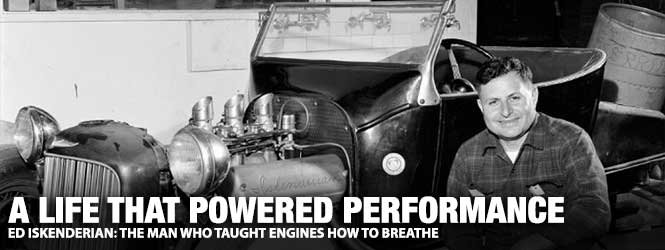
It is with great sadness that we share the loss of Ed “Isky” Iskenderian. He passed on February 4, 2026, at the age of 104. Iskenderian did not merely witness the birth of American hot rodding; he helped engineer it.
In an era when speed equipment was nearly non-existent, and knowledge was earned through trial and error, Iskenderian turned curiosity, necessity, and raw mechanical intuition into an industry that still defines performance today.
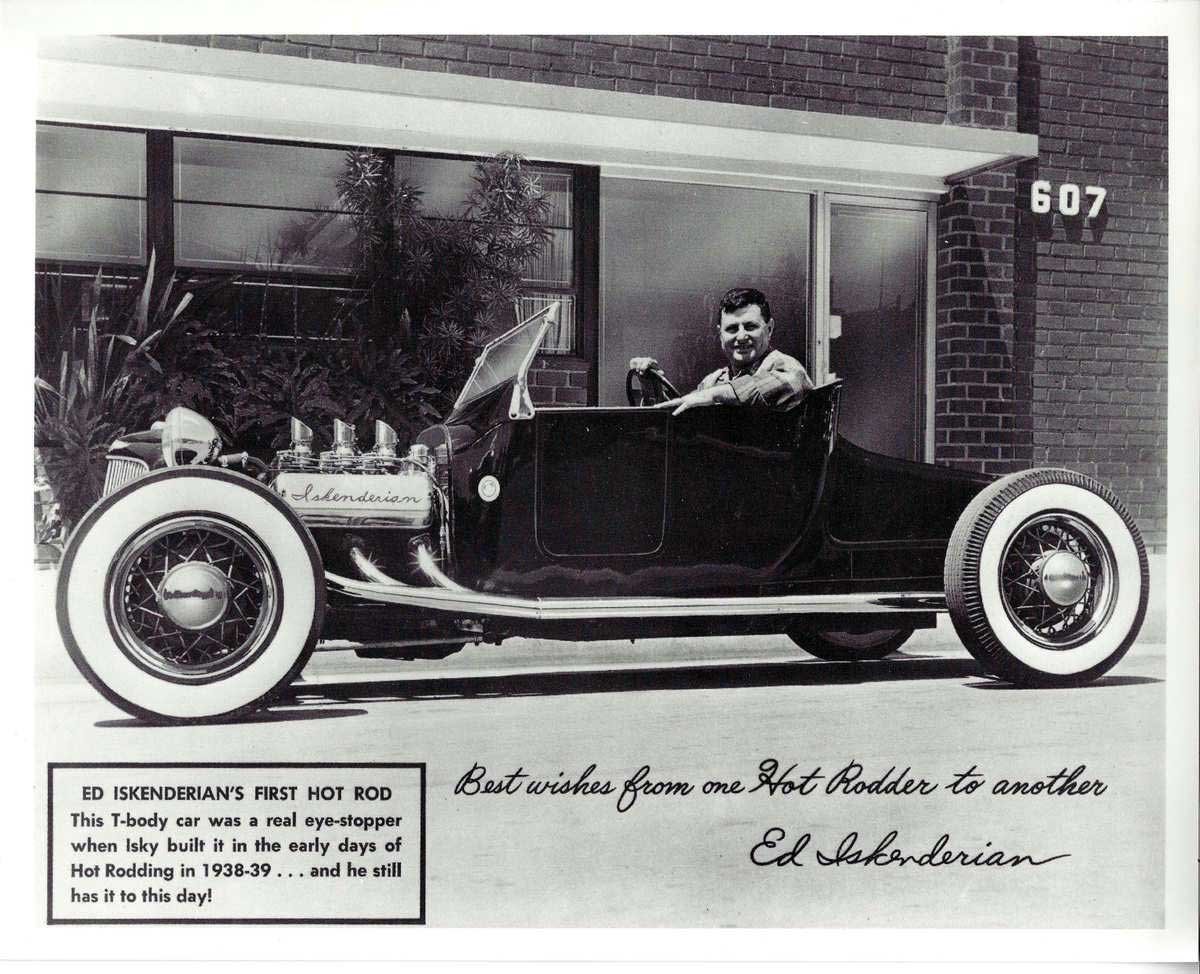
Above: Iskenderian’s famed T/V8, wearing its distinctive “turtle deck” bodywork, is widely regarded as the oldest surviving hot rod in existence. After a flurry of early experimentation, the car settled into a configuration that remained essentially unchanged for more than six decades. Several Flathead V8s lived between the frame rails over the years, paired with a variety of intake manifolds and carburetor combinations. The MAX-F heads were topped with one-off aluminum valve covers, their flowing script hand-scribed by Iskenderian’s friend, John Athan. (Photograph – Ed Iskenderian’s collection)
Born on July 10, 1921, in California to Armenian immigrant parents, Iskenderian grew up around hard work and problem-solving. After his family settled in Los Angeles, he found his calling in machinery.
In his middle school and early high-school years, Iskenderian fixed HAM radios for people in the local area. In his later high school years, he gravitated toward shop classes, engines, and machine tools. Like many youths of his generation, he purchased and modified a hot rod with his earnings from the radio repairs.
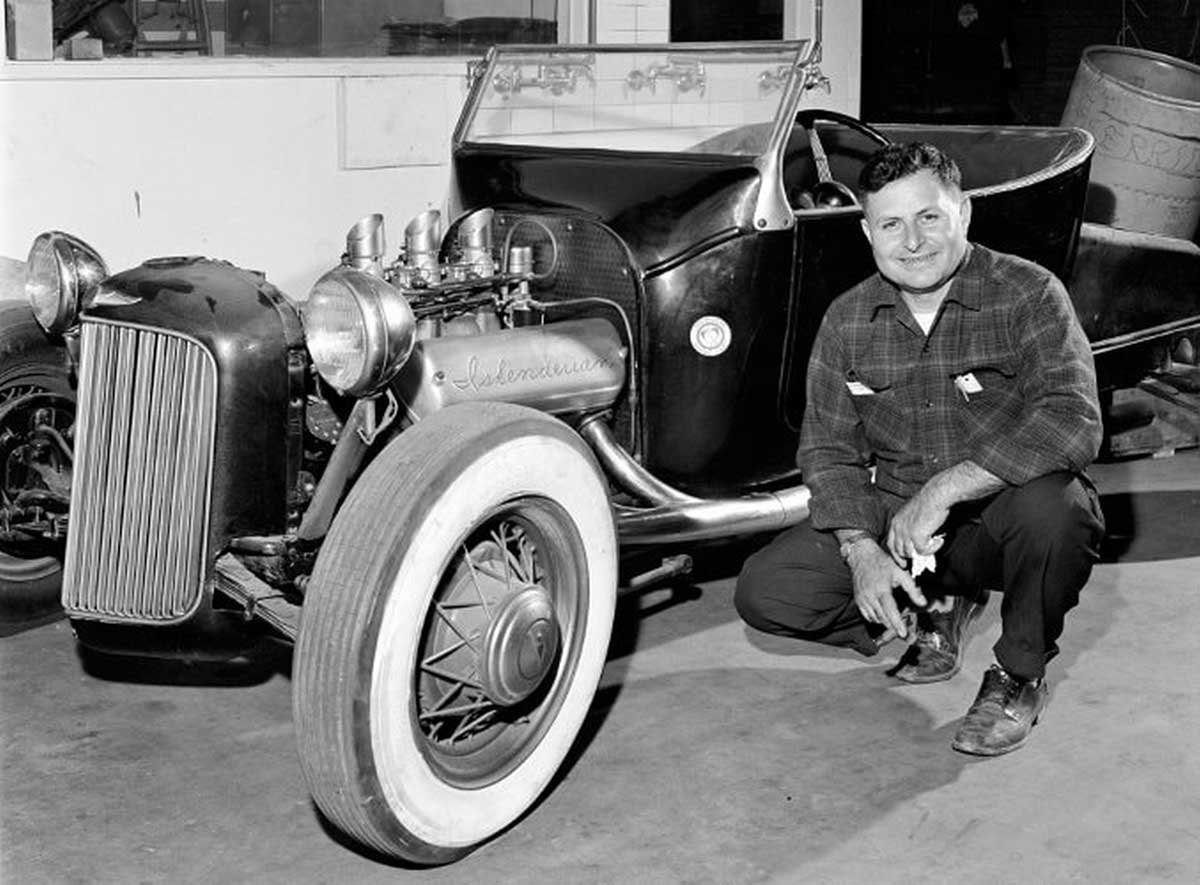
Above: Iskenderian’s “T” wore deep black lacquer, offset by red Ford steel wheels capped with V8 hubcaps. Suspension duties were handled by Houdaille (pronounced “Who-die”) knee-action hydraulic shocks, while a uniquely modified Pontiac grille gave the car its own unmistakable face. The doors were welded shut in true early hot-rod fashion, and the interior was trimmed in tan leather. A cluster of instruments was neatly grouped within a spun-metal gauge housing, completing the purposeful, hand-built look. (Photograph – Ed Iskenderian’s collection)
Iskenderian pieced together a Model T roadster, originally hot-rodded by his friend John Athan, who had purchased the modded Model T from another. He learned how Ford flathead engines responded to timing, lift, and airflow long before those terms entered the automotive vernacular.
World War II interrupted nearly everything, but it sharpened Iskenderian. While serving in the U.S. Army Air Corps, he flew supply missions in the Pacific Theater. After the war, hot rodding exploded, but parts availability did not.
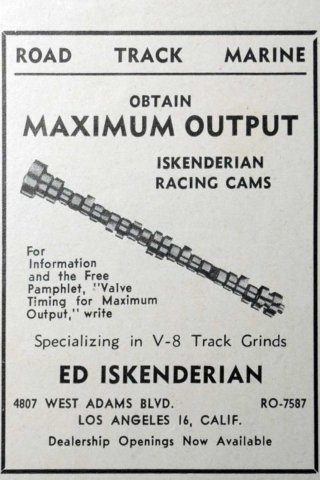
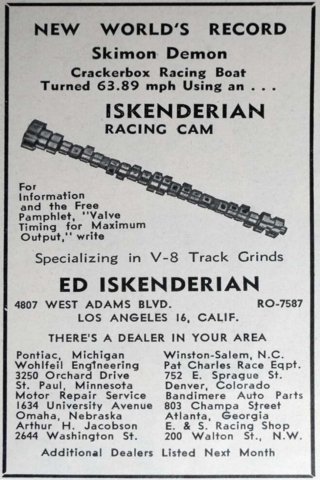
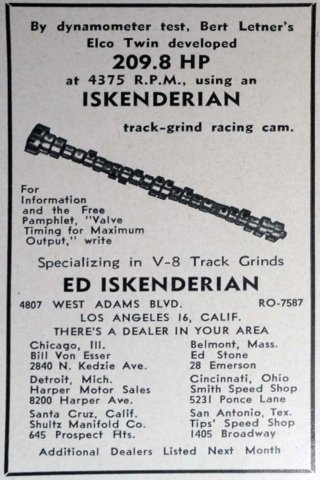
Above Left: Iskenderian quickly recognized the potential of the newly launched Hot Rod Magazine, placing advertisements in its earliest 1948 issues and continuing to appear in its pages for the next five decades. (Photograph – Hot Rod Magazine, April 1948) Above Center: By October 1948, Iskenderian had established a nationwide dealer network and was already assembling a roster of world-record-holding customers. Among the earliest was a record-setting top-speed run by a boat. (Photograph – Hot Rod Magazine, October 1948) Above Right: An engine fitted with an Iskenderian camshaft surpassed the 200-horsepower mark during dyno testing in 1949. The recorded 209.8 horsepower represented a remarkable achievement for the era. (Photograph – Hot Rod Magazine, March 1949)
When Iskenderian could not buy the camshafts he wanted, he decided to make them. In 1946, armed with an old cylindrical grinder and a willingness to experiment, he began grinding camshafts in earnest. That moment marked the beginning of Iskenderian Racing Cams, better known simply as Isky.
Early on, Iskenderian understood something fundamental. The camshaft was the brain of the engine. While carburetors and cylinder heads drew attention, it was the hidden valve motion that defined how effectively an engine breathed.
Isky cams quickly earned a reputation for delivering real power, not speculative gains, and racers took note. Dry lakes cars, dragsters, circle track machines, and street hot rods all began relying on Iskenderian profiles.
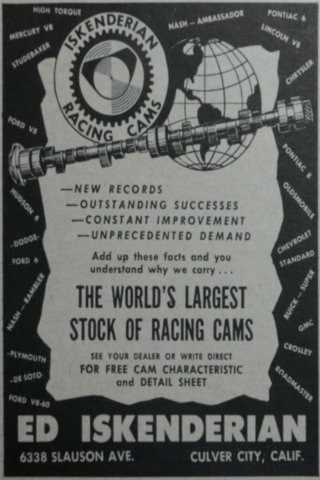
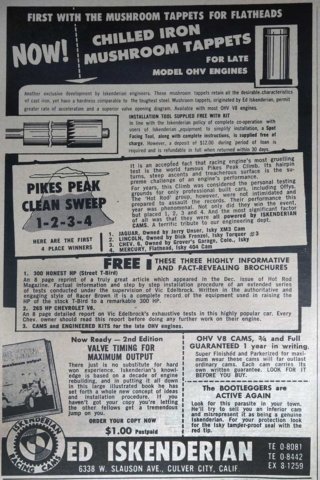
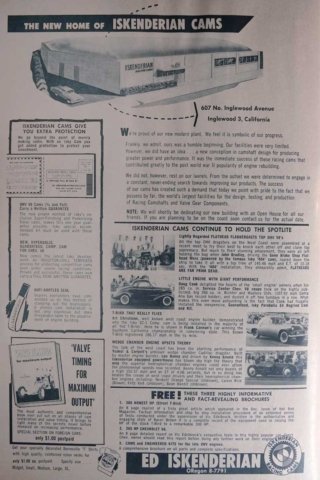
Above Left: Iskenderian continued to promote his growing operation, boldly claiming the world’s most extensive inventory of racing camshafts. (Photograph – Hot Rod Magazine, January 1953) Above Center: Chilled-iron mushroom tappets were in high demand during the late 1950s, and Iskenderian formally introduced his own version in 1957. His camshafts continued to dominate competition and set records across multiple forms of racing. (Photograph – Hot Rod Magazine, February 1957) Above Right: For years, Iskenderian secured the coveted inside front cover, known as Cover Two, of Hot Rod Magazine. In 1957, he used that prime real estate to unveil his new headquarters. (Photograph – Hot Rod Magazine, April 1957)

Innovation followed at a relentless pace. Iskenderian pioneered hard face overlay camshafts, dramatically improving durability. He advanced the hydraulic lifter cam design and roller cam technology, and conceived high-quality chilled-iron lifters that withstood the brutality of Top Fuel drag racing.
His work with advanced valve springs and metallurgy expanded safe engine speeds and reliability. Later, computer-aided design permitted Iskenderian to refine cam profiles, combining aggressive lift with controlled valve motion.
Iskenderian was not only an innovator. He was a natural ambassador for hot rodding. Long before branding became a buzzword, Isky shirts, decals, and advertisements appeared in Hot Rod Magazine. He understood that racers wanted to belong to something larger than themselves.
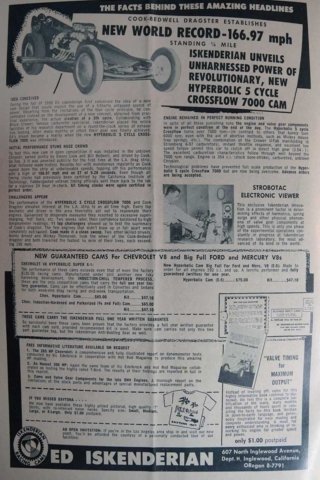
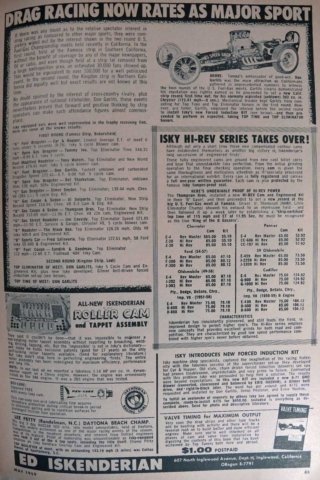
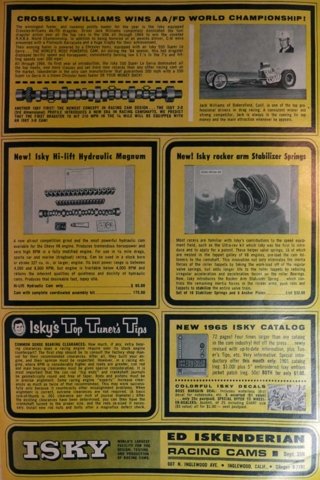
Above Left: By the late 1950s, drag racing was exploding in popularity, and Iskenderian was there with the best performance parts of the era. Dragsters running nitromethane, or gasoline during the nitro ban, frequently relied on Gen I Hemis, and a growing number of Isky-equipped engines began finding their way into the winner’s circle. (Photograph – Hot Rod Magazine, January 1959) Above Center: A young “Big Daddy” Don Garlits worked closely with Iskenderian for years, forming a partnership that proved mutually beneficial as both careers accelerated. (Photograph – Hot Rod Magazine, May 1959) Above Right: Another championship added to the tally. In 1965, Iskenderian expanded his product line with the introduction of spring stabilizers, further strengthening the Isky catalog. (Photograph – Hot Rod Magazine, March 1965)
His contingency programs rewarded grassroots racers and helped legitimize motorsports sponsorship. Names like Don Garlits benefited directly from Iskenderian support during the formative years of professional drag racing.
In 1963, Iskenderian helped formalize the industry he had helped create. Alongside other pioneers, he co-founded the Speed Equipment Manufacturers Association, later known simply as SEMA, and served as its first president. The organization gave performance manufacturers a unified voice and helped transform speed parts from backyard experiments into a renowned industry.
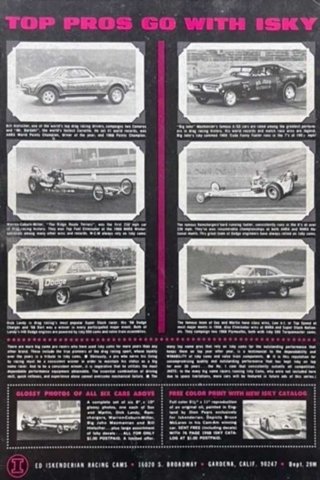
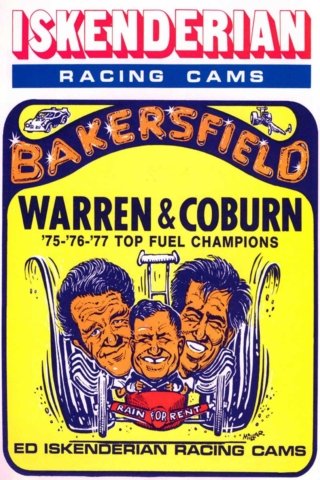
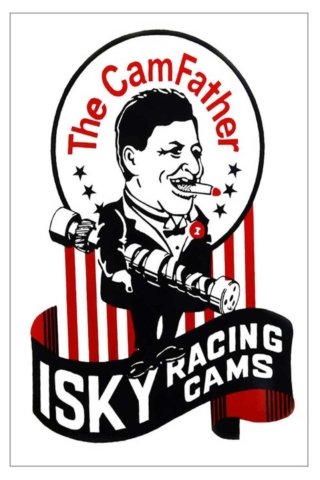
Above Left: By the late 1960s, the roster of top competitors relying on Isky cams had reached a fever pitch. Top Fuel and Funny Car Gen II Hemis, Super Stock and Stock Gen II Hemis and wedges, and even other forms of competition all benefited from Iskenderian’s camshafts and valvetrain components. Above Center: In the era of the rear-engine dragster, Isky cams continued to keep the Fuelers in the winner’s circle. Warren & Coburn captured multiple victories at Bakersfield events in the mid-1970s. Above Right: Iskenderian earned the enduring nickname “The CamFather,” a testament to his unmatched experience and deep industry knowledge, a title well deserved. (Photographs – Ed Iskenderian’s collection)
Recognition followed, though Iskenderian never seemed motivated by it. He was inducted into multiple halls of fame, honored by manufacturers, and praised by generations of engine builders. Even in his later years, he remained a living link to hot rodding’s earliest days, a man who could trace modern valvetrain theory back to hand-ground lobes and intuition.
Iskenderian’s influence remains inseparable from performance engineering. Every camshaft discussion, every debate about duration, lift, and overlap, pushes back to pioneers like Iskenderian who proved that precision inside the engine mattered more than chrome on the outside.
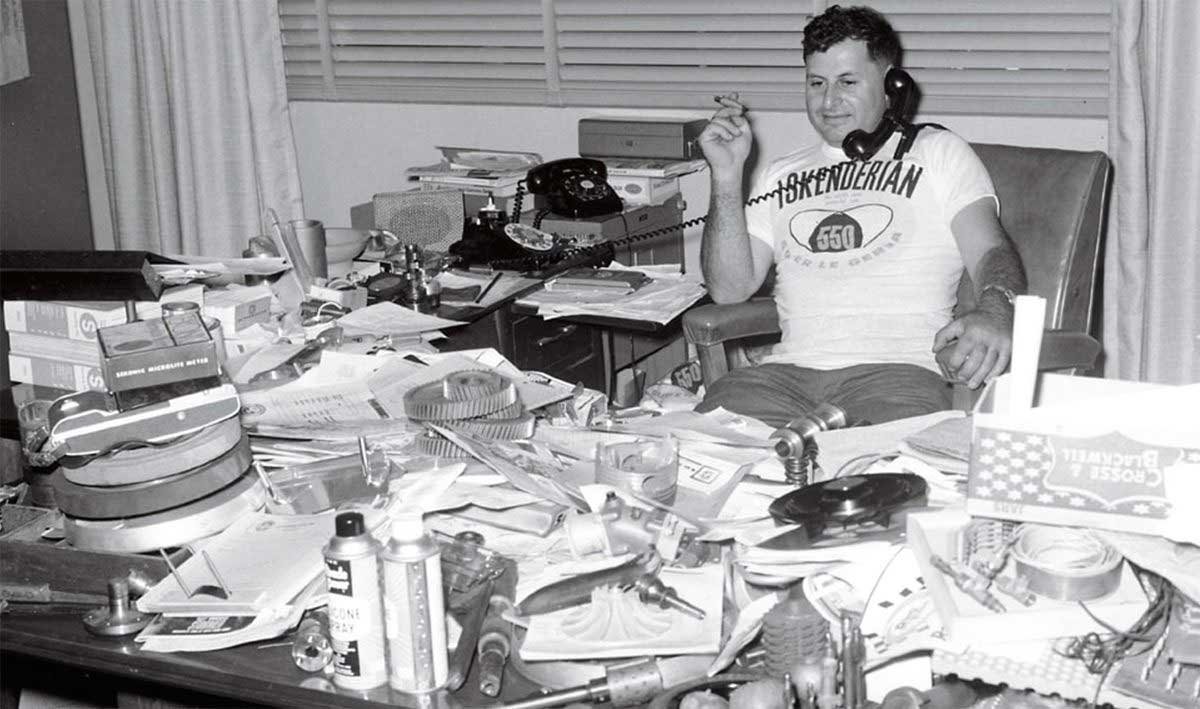
Above: Iskenderian’s desk was famously cluttered. A collector of all things automotive, he filled rooms and outbuildings with his vast array of “stuff.” Yet despite the apparent chaos, he rarely misplaced anything and could almost always locate what he needed with surprising speed. (Photograph – Ed Iskenderian’s collection)
He acquired the nickname “The CamFather” not through marketing flair alone, but through decades of invention, risk-taking, and an unyielding belief that engines could always be made better. In that sense, Iskenderian did more than build camshafts. He shaped the rhythm of American performance itself. Rest in peace, Ed Iskenderian.