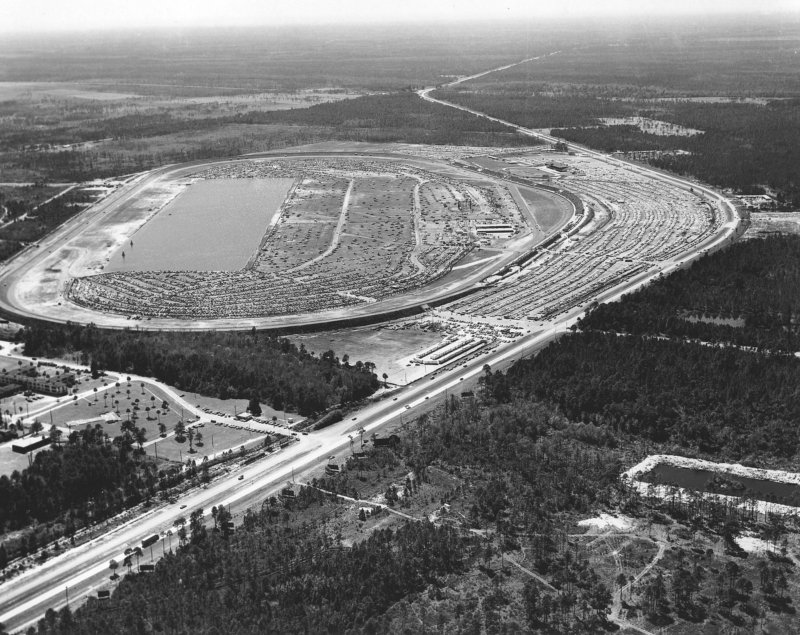
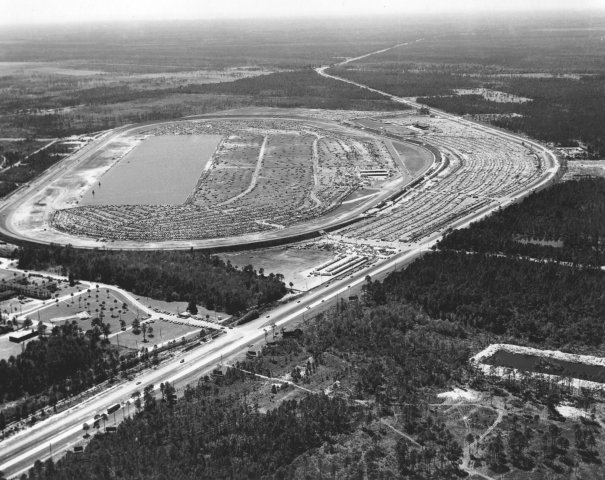
In 1959, Bill France, Sr. built the Daytona International Speedway to replace the Beach and Road Course. France wanted to make the Daytona International Speedway the fastest track in the world. At the time, the World’s Closed Course speed record was held by Tinley Park, Illinois Tony Bettenhausen at 177.38 mph set at Monza, Italy.
The seed for the idea may have been planted when George Amick (who made his first Indy 500 start in 1958) found himself putting down a lap of 176.887 mph at the new Daytona International Speedway (DIS) in the Norm Demler owned “laydown roadster” with Meyer Drake Offenhauser power. Unfortunately, Amick died in a terrible crash at the conclusion of a 100-mile race at DIS on April 4, 1959.
 By 1960, France had a problem, as the two and a half mile Daytona track was considered to be the most dangerous racetrack in the world, after yet another driver was killed running at high speeds on it’s high banks.
France took on the problem as he always did. Head-on. He used the same creativity that he had used to create NASCAR and DIS. He said he would pay $10,000 to anyone who would race around DIS at 180 mph. The attraction of fame and money did not go unchallenged.
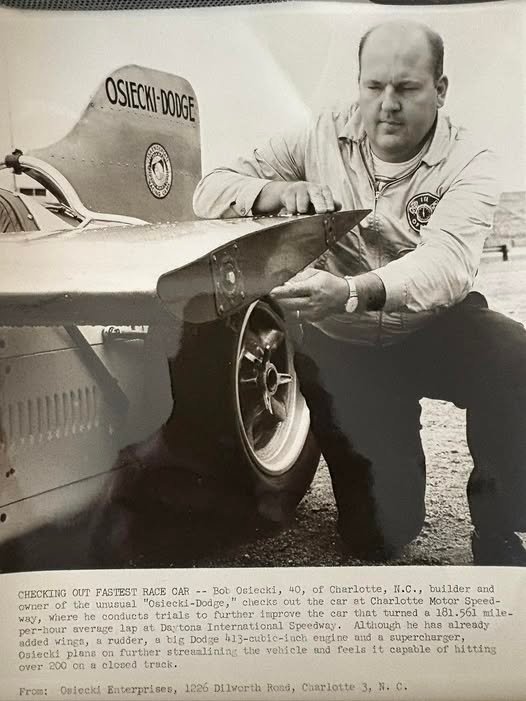
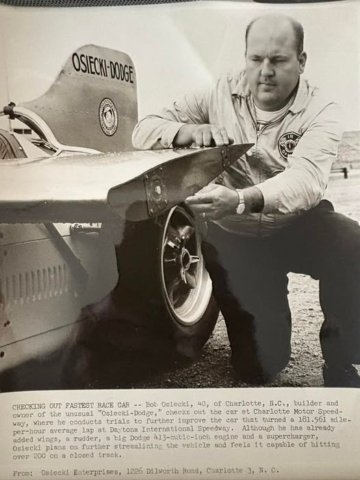
Among the challengers was a man with quite a background in speed, a Speed Shop owner in Charlotte, North Carolina named Bob Osiecki. Not only did Osiecki understand business, he craved speed as he also owned and operated a drag strip in Chester, South Carolina. Osiecki also had a background with Bill France and NASCAR.
Born in New York but raised in Southwest Atlanta. He studied engineering at Georgia Tech before joining the Army Air Force in 1940. After the war Osiecki returned to Atlanta but passed on going to college, instead he pursued a career of designing and building race cars and custom speed equipment from his namesake garage located just southwest of Georgia Tech.
Race cars that he designed and sponsored were winning at Atlanta’s Lakewood Speedway on Daytona’s Beach and Road Course and on dirt tracks throughout the Carolinas. Chrysler Corporation hired Osiecki to manage their NASCAR program in 1957 and the owner-mechanic fielded entries for the next six years.
Osiecki was one of nearly 40 drivers, owners, promoters, mechanics and journalists that France brought together on December 14, 1947, at the Streamliner Hotel in Daytona Beach that changed history. Out of that meeting came the creation of the National Association of Stock Car Auto Racing (NASCAR).
As a NASCAR Car Owner Osiecki entered 30 cars in NASCAR sanctioned races beginning with the Poor Man’s 500 on May 30, 1951, and ending with the Dixie 400 on October 28, 1962, at Atlanta with Ralph Earnhardt driving to a 14th place finish. While none of his cars won a NASCAR race, they did finish in the top five twice and in the top ten on five occasions. In addition to Earnhardt other well-known drivers were Darrel Dieringer and Marvin Panch.
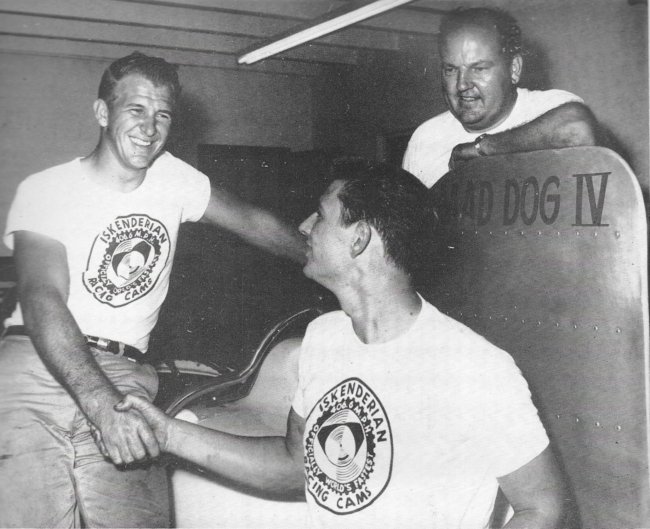
As for the drag racing aspect, the Chester Drag Strip in Chester, South Carolina operated from 1956 through 1960 with drag racing conducted on a 150-foot wide, mile long asphalt runaway at the Chester Airport. Osiecki managed the races which were conducted by the International Timing Association. The dragstrip quickly became one of America’s premier dragstrips due to his vision.
So, Bob Osiecki, a man just like Bill France, who thought out of the box, decided to take on another challenge and go after Bill France’s $10,000s. In January 1961, he purchased a Frank Kurtis Indy Roadster built in 1958 for Ray Nichels. The car had a wheelbase of 100 inches, and it weighed 2350 pounds. The racer that had once been used for tire testing by Firestone.
The chassis was pretty complete but had no engine. Osiecki using his “big engine” background took a 412 cubic inch hemi Chrysler V8 and shoehorned it into the roadster. But before fitting the Chrysler engine into the chassis, he had it bored out to 450 cubic inches, added fuel injection and a GM Supercharger that Ed Iskenderin fitted to the top of it. The engine was prepped in Iskenderin’s West Coast shop and sent back to South Carolina. With the engines 15:1 compression a real crack at the record could take place.
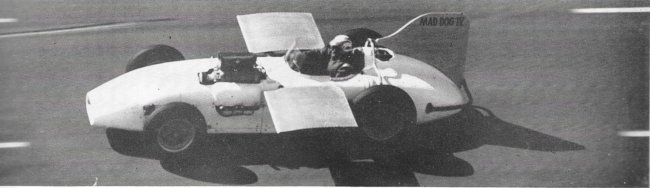
Osiecki chose Firestone tires that were developed by the company for racing at Monza. These three ½- inch wide tires were in short supply, but Firestone gathered unused tires from race teams. Some of the tires might have been two years old. The car was outfitted with disk brakes. With a 15:1 compression the fuel of choice was alcohol based.
In just one month, the car was ready for Daytona Speedweeks. It was the talk of Speedweeks. No one thought it possible…except Osiecki. At Speedweeks, Fireball Roberts set a new track record in qualifying for the NASCAR Daytona 500 at 155.709 mph. That was 25 mph slower than the goal. Osiecki’s first driver could only better Roberts mark by just two miles per hour.
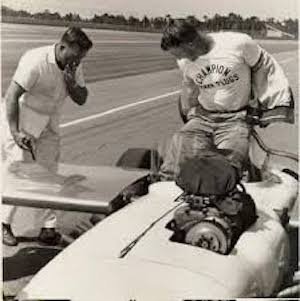
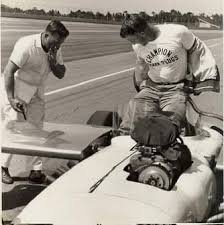
Hotshoe Larry Frank was next, and he turned a lap of 166 mph, but on the next lap spun it out on the backstretch leaving a 2,100 footlong black mark on the track and banging up the tail and nose. Frank told Osiecki it couldn’t be done and left. Osiecki thought otherwise.

Osiecki decided to reach out to Georgia Tech Professor John Harper in the Institute’s then School of Aeronautics, who’s teaching and research focused on aircraft aerodynamics, performance and design.
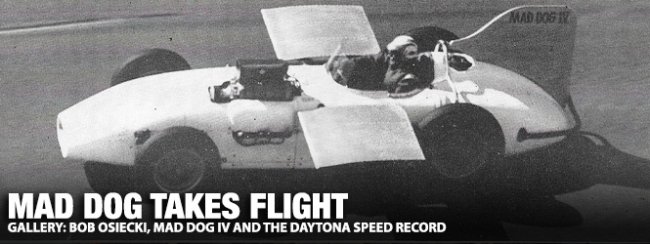
Osiecki shipped the Mad Dog IV from Charlotte to Georgia Tech, where Harper oversaw the daily operation of the nine feet diameter wind tunnel located on the ground floor. The Professor and his students designed and tested a pair of inverted airfoils-wings in effect- each measuring three square feet. Harper also created a vertical stationery tail fin, similar to an airplane rudder to increase stability.
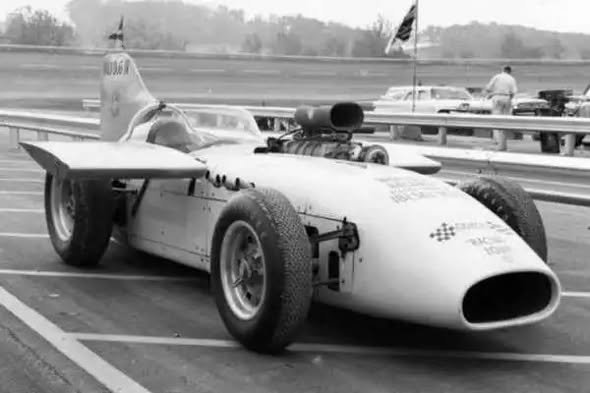
Osiecki turned down offers to drive from NASCAR stars and remembered fearlessness of Fuel Dragster driver Art Malone and contacted him. Malone had a young family and needed the money. But Malone had only gone fast going straight and needed extensive testing at the track at lower speeds. Over seven days and 14 sets of tires they got the car into the high 160s with no handling problems.
On August 5, 1961, Malone on his first attempt at the 180 mark and set a new closed course record at 177.479 mph., bringing the record back to the USA. On August 21, Malone set another new record of 178.253 mph. This brought reporters from around the world and curious fans to the speedway.
On August 23, Malone nearly lost his life in a 178 mile per hour spinout in the same area Frank has spun out, but like Frank, Malone did not hit anything. You can only imagine the courage it took for Malone to know how close he came to losing life, but to continue on.
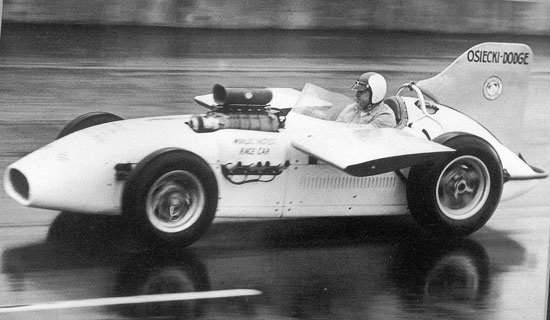
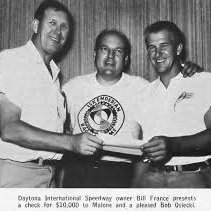
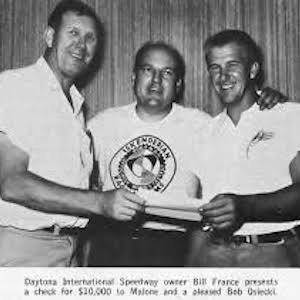
On August 28, 1961, Art Malone drove Bob Osiecki’s Mad Dog IV to a lap record of 181.56 mph. Big dreamer Bob Osiecki never doubted. After the record run, Osiecki who looked like a wrestler kissed Malone unashamedly and said, “I knew we’d do it.” Bill France gladly wrote the check for $10,000. Years later, Tom Osiecki, Bob’s son, said his father invested $35,000 in preparing Mad Dog IV to break the record and he gave Malone the $10,000 check. His son did say that Osiecki was able to recoup part of the expenses by taking “The Fastest Race Car in the World” on a barnstorming tour.
The Daytona Speed record proved to be Bob Osiecki’s signature accomplishment. He leveraged his celebrity status and promoted auto shows throughout the Southeast and opened his own Dodge dealership in Florence, South Carolina in 1964. The dealership also housed the Osiecki Automotive Mechanic School, which Bob created to share his skills and knowledge with a full class of 60 aspiring students. As a contribution to his community, he offered the training at no cost to his students.
Unfortunately, Bob Osiecki died in 1964 at the age of just 43, just three years after his marvelous machine broke the World Speed record at Daytona.