There are few sounds more frustrating to a Mopar enthusiast than a high-performance engine that barely turns over when the starter is engaged. The battery is fully charged, the connections look good, and the starter is supposedly rated for plenty of power. Yet the engine cranks slowly, or worse, the starter struggles against compression until everything comes to a halt.
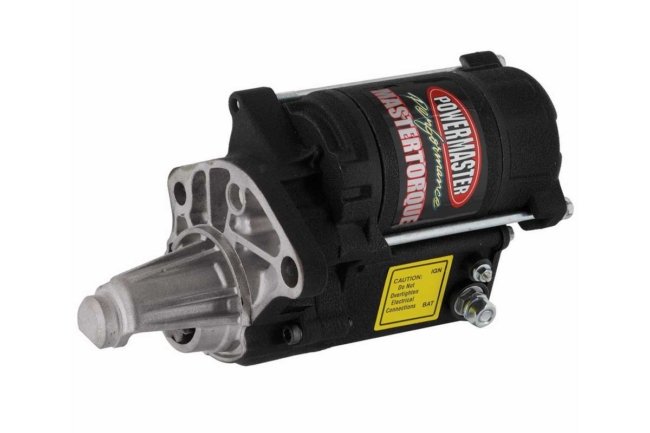
Above: PowerMaster Mastertorque starters deliver 180 lb/ft of torque, making them capable of cranking engines with compression ratios up to 14.0:1. They clear stock oil pans, while select models also clear kick-out pans. Multiple mounting positions are available on some models, including inverted installation. A black wrinkle finish is standard, with chrome available on select models.
The problem may not be the amount of power the starter is rated to produce. It may be how that power is produced.
This is where understanding torque becomes important, particularly when dealing with high-compression big-blocks, stroked small-blocks, race engines, or any Mopar that has significantly more cylinder pressure and internal resistance than it did when it left the factory.
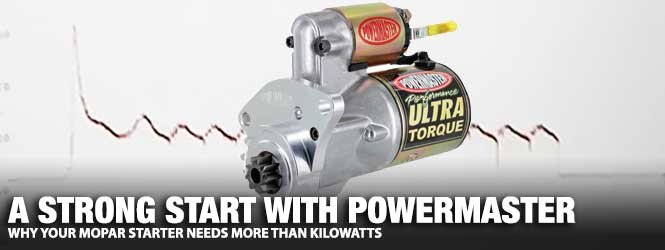
That is also where Powermaster Performance enters the picture. Powermaster manufactures high-performance starters designed for applications ranging from street-driven muscle cars to serious competition vehicles.
Rather than simply looking at a maximum power rating, Powermaster provides dyno data that shows how its starters perform across their operating range. To understand why that matters, however, it helps to understand what a starter motor is really doing.
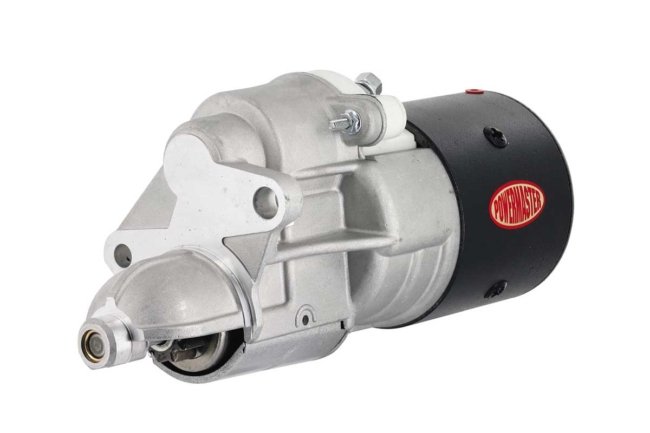
Above: PowerMaster Original Look Hi-Torque starters deliver the factory appearance with upgraded modern technology and performance. They look stock on the outside, but are stronger where it counts, with upgraded armatures, field coils, and drives. Every PowerMaster starter is backed by its dyno-tested Proof of Performance guarantee.
Torque is rotational force, the twisting force available to turn the engine against resistance. High compression, large displacement, tight piston rings, heavy oil, superchargers, turbochargers, and other factors can increase the torque required to crank an engine.
That resistance is particularly important during the compression stroke. As the piston approaches top dead center, cylinder pressure rises, and the starter must produce enough torque to continue rotating the crankshaft. A high-compression performance engine can therefore place substantially more demand on the starter than a stock engine.
Unfortunately, starters are commonly identified by their kilowatt rating. Kilowatts describe mechanical power, which is the combination of torque and rotational speed. While power is certainly important, a kilowatt rating by itself does not tell us how much torque a starter can produce at a particular RPM. And that distinction matters.
We tend to think of an engine as having a powerband. A particular engine might make its peak torque at 4,000 RPM and peak horsepower at 6,000 RPM. Electric motors have their own torque-and-speed characteristics.
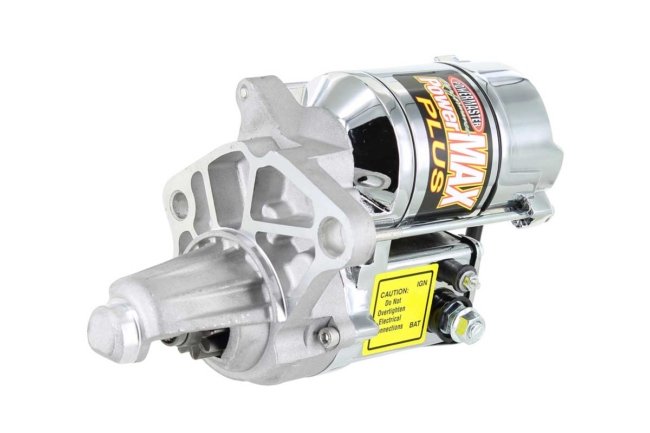
Above: PowerMaster PowerMax starters deliver 170 lb/ft of torque, providing strong, reliable cranking for engines with average compression ratios. Their compact design clears stock oil pans, with select models also fitting kick-out designed pans. The Infini Clock mounting system allows flexible positioning for easier installation and fitment. Dyno reports and mounting bolts are included.
At zero RPM, a starter motor produces its maximum torque. But because it is not turning, it produces zero mechanical power. As the motor begins to rotate, RPM increases and torque decreases. Mechanical power then rises until it reaches a peak somewhere in the operating range. As RPM continues to increase, power eventually falls.
This creates a torque-and-power curve that is every bit as important to understanding starter performance as the power curve is to understand an engine.
Consequently, two starters with the same kilowatt rating can have vastly different characteristics. One may produce its peak power at a relatively high RPM with less torque, while another may produce more torque at a lower RPM.
For a typical stock engine, either characteristic may be perfectly adequate. For a high-performance Mopar, however, the starter’s ability to produce substantial torque at low cranking speeds can become particularly important.
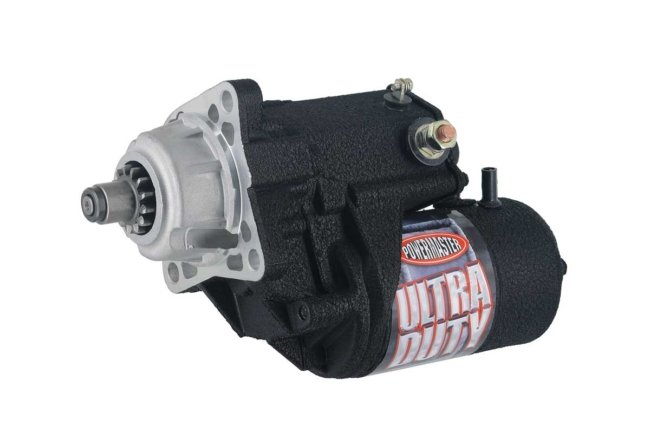
Above: PowerMaster Diesel Ultra Duty starters for 1994-2002 Cummins feature a 3.75:1 gear reduction and 3.0 HP motor, providing the cranking power needed to turn over high-performance diesel engines in demanding conditions. A durable black wrinkle finish helps resist corrosion, and every starter is backed by PowerMaster’s dyno-tested Proof of Performance guarantee.
Think about what happens when a starter encounters a high-compression engine. The engine requires a certain amount of torque simply to continue turning the crankshaft. As the load increases, the starter slows down.
While the motor slows under load, the current draw increases dramatically. This is where things can get hot.
At extremely low RPM, particularly as the starter approaches a stalled condition, a tremendous amount of electrical energy can be converted into heat inside the starter rather than useful mechanical work.
The motor’s copper losses increase approximately with the square of current. In simple terms, doubling current does not merely double the heat produced by resistance, it can increase those losses by approximately four times.
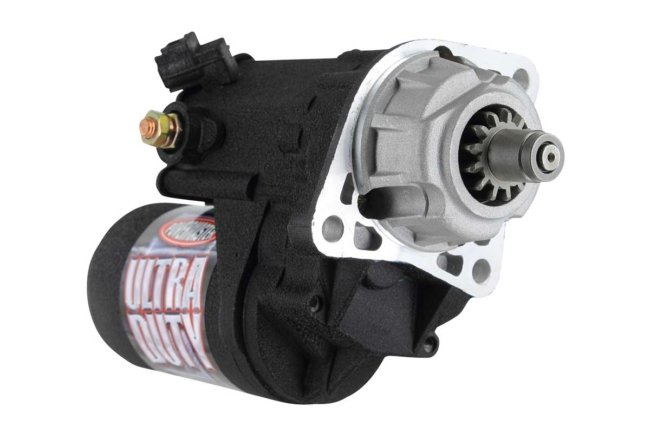
Above: PowerMaster Diesel Ultra Duty starters for 2003-2006 5.9-liter Cummins engines pack plenty of cranking power into a compact package. The 3.0 HP motor uses a 3.75:1 gear reduction to handle the demands of high-compression diesel engines. A black wrinkle finish helps ward off corrosion.
That is why repeatedly asking an undersized starter to crank a high-compression engine can result in rapidly increasing temperatures and, eventually, starter failure. The objective, therefore, is not simply to select the starter with the largest kilowatt number.
A starter with a torque curve suited to the application can be more valuable than one with a higher peak-power number. For a high-compression-ratio engine, the ability to produce substantial torque while cranking at low RPM can help the starter accelerate the engine through its compression cycles without excessive current draw and heat buildup. In simpler terms, how a starter makes its power can be just as important as how much power it makes.
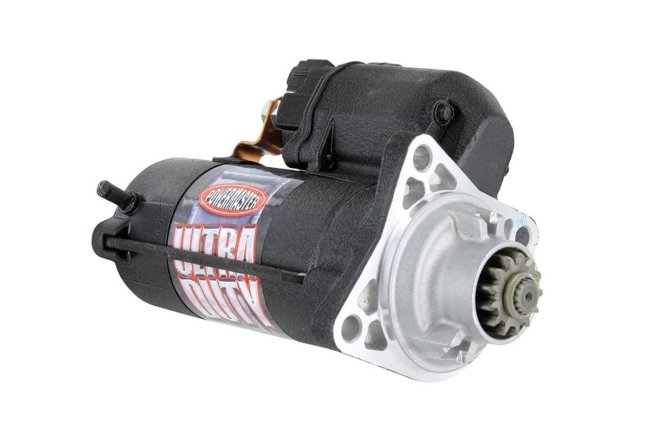
Above: PowerMaster Diesel Ultra Duty 2007-2022 5.9/6.7 Cummins starters use a 3.75:1 gear reduction and 3.0 HP motor to deliver the power needed to turn over even the highest of compression diesel engines.
Even the best starter cannot overcome a poor electrical system. Voltage is extremely important for starter performance. So are the cables, connections, grounds, and disconnect switches between the battery and starter.
A starter can draw several hundred amps while cranking. When that much current passes through an undersized, damaged, excessively long, corroded, or overheated cable, resistance in the circuit creates voltage drop. The result is less voltage actually reaching the starter.
That can create a frustrating situation where a starter appears to be inadequate when the real problem is the electrical system feeding it.
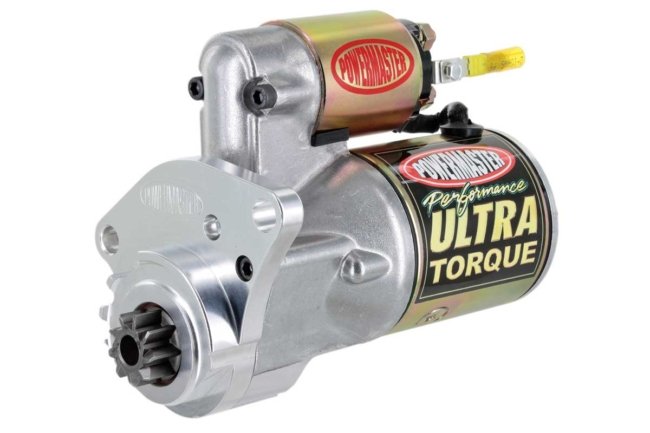
Above: PowerMaster Ultra Torque starters deliver 250 lb/ft of cranking torque and are rated for engines with compression ratios up to 18:1. With 3.4 HP and a 4.4:1 gear reduction, they provide the power needed for demanding engines. A two-position billet aluminum mounting block allows flexible installation. Every PowerMaster starter is made in the USA.
The same applies to connections. A battery cable can look perfectly acceptable from the outside while a poor connection, corroded terminal, inadequate ground, or undersized cable creates substantial resistance under load. The starter does not know whether the problem is a weak battery or a bad cable. It simply sees less voltage.
The battery itself has internal resistance. Under the enormous current demand of a starter motor, that resistance causes battery voltage to fall.

A battery capable of delivering high starting current, with low internal resistance and an appropriate CCA rating, can therefore provide substantially better cranking performance.
High-output AGM batteries are particularly well suited to performance applications where strong starting performance and resistance to vibration are important. But regardless of battery type, the goal remains the same: provide the starter with sufficient voltage while it is demanding hundreds of amps.
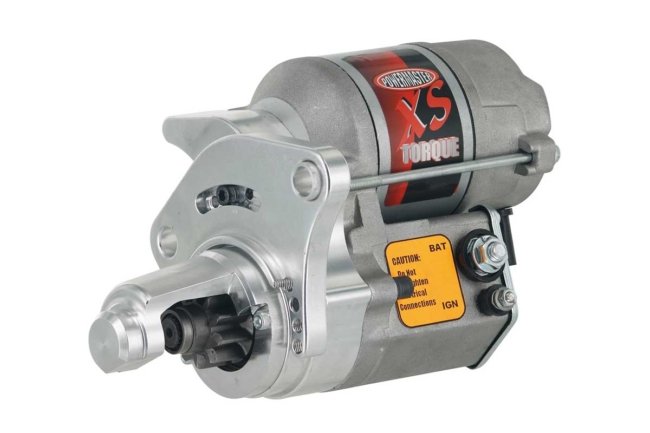
Above: PowerMaster XS Torque starters deliver up to 200 lb/ft of cranking torque through a 4.4:1 gear reduction, making them suitable for engines with compression ratios up to 18:1. A durable billet adapter provides a secure mounting point. If the OE starter cleared the oil pan, the compact design will also clear the pan. Select models are available in chrome, with dyno test results included.
This is why a performance starter needs to be considered as part of a system. A powerful starter connected to a marginal battery with undersized cables is not going to deliver the performance its specifications suggest. This is one area where Powermaster takes a different approach to communicating starter performance.
When you purchase a Powermaster starter, you receive a dyno sheet showing the starter’s measured performance across its operating range. Rather than providing only a single kilowatt rating, the data allows the user to see the relationship between torque, RPM, current, and power. That is valuable information when selecting a starter for a modified Mopar.
A starter’s maximum power rating tells only part of the story. Knowing how much torque the motor produces at the low RPM where a high-compression engine is being cranked provides a much better understanding of whether the starter is suited to the application.
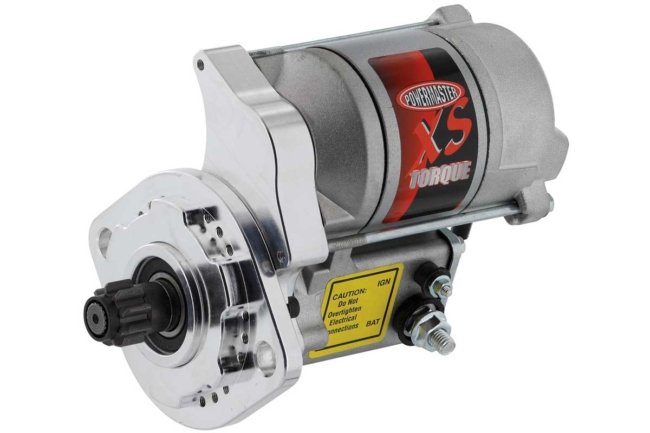
Above: PowerMaster XS Torque starters with 172 teeth fit the 1957-58 Hemis and deliver up to 200 lb/ft of cranking torque with a 4.4:1 gear reduction. A billet mounting block adds strength, while the compact design clears the oil pan, just like the OE unit.
Powermaster dynamically evaluates its starters throughout their operating range, providing data that illustrates how the starter performs under load. For the enthusiast building a performance Mopar, that information can help take some of the guesswork out of selecting the appropriate starter.
The lesson is simple: do not choose a performance starter solely by its kilowatt rating. Look at its torque characteristics, consider how much resistance the engine presents, and make sure the battery, cables, grounds, connections, and switches can deliver the voltage and current the starter needs.
Because when a high-compression Mopar fires immediately instead of grinding against the starter, the difference is not just in the starter’s advertised power. It is in the starter’s ability to turn that electrical energy into the torque needed to get the crankshaft moving.
For more information and to get the best starter for your Mopar, take a few minutes to contact the representatives at Powermaster. Your Mopar will thank you.