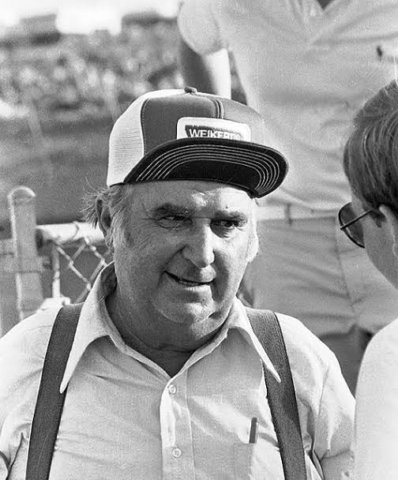
At what point the idea was conceived is hard to say, but it was certainly not a surprise to diehard race fans about what promoter was most capable of pulling it off. Earl Baltes, the owner and promoter at Eldora Speedway in northwest Ohio was a man who dreamed big.
In 1971, Baltes created the biggest Dirt Late Model race in the country in the World 100. Later he added the $50,000 to win King’s Royal for Winged Sprint cars and then the $100,000 to win Historical Big One for the same class. In 1994, it was the $100,000 to win Dream for Dirt Late Models then in 2000, he came up with Eldora Million for Dirt Late Models a race that because of weather was finally run in June 2001. The Eldora Million paid $1,000,000 to the winner.
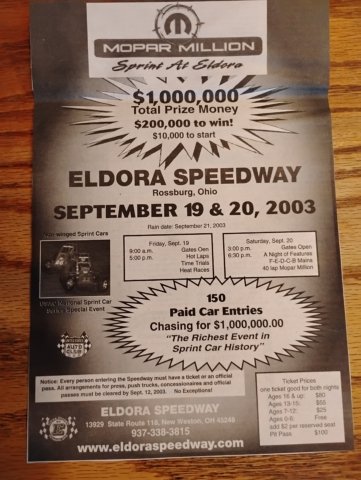
So, after hints of a million-dollar race for Sprint Cars had been floating around for some time, it was not a surprise when on January 13, 2003, at the Chili Bowl Midget races in Tulsa, Oklahoma, Baltes made it official. The only question left was whether it was non-winged or winged sprint cars. Baltes cleared that up as well.
“Basically, what I can confirm is, yes, Eldora Speedway will hold a race for non-winged sprint cars, with $1,000,000 in prize money on the line.” said Baltes. “The race will be on Friday, September 19 and Saturday, September 20 with a weather date of September 21. I don’t have the complete breakdown yet, but the feature will pay $200,000 to win and $10,000 to start – everyone will make some money.”
On January 30 in Indianapolis, it was announced that Baltes had entered into an agreement with the United States Auto Club (USAC) that gave the race Special Event status by the National Sprint Car Division of USAC. Meaning that all car specifications will be announced and enforced through USAC, while the conduct and coordination of the race format will be a collaboration between Baltes and USAC,
“I’m more excited about the interest that this race has generated, than anything else I’ve promoted,” said the 81-year-old Baltes. “and by bringing USAC on board, it is sure to be a first-class hit.”

“This race is obviously one of the most important races in our 47-year history,” said USAC President/CEO Rollie Hemling. “It’s huge for our participants and we are extremely proud to have been selected as the sanctioning body. We anticipate the top drivers and equipment from across America for this race and look forward to our involvement. Earl and his staff have long been part of our family, and we are excited for them as we are for our participants.”
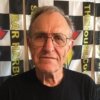
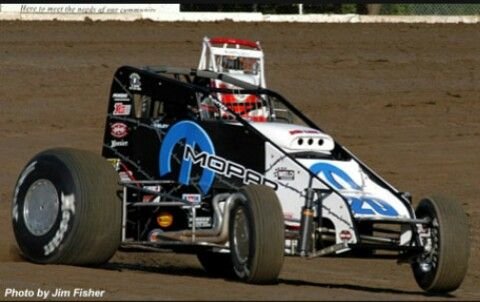
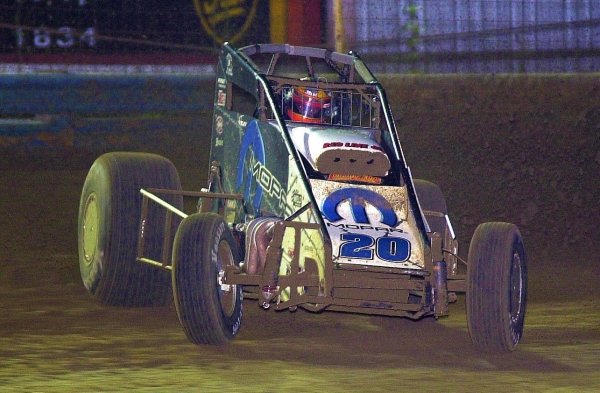
According to Kevin Miller, recently President of USAC for many years, but in 2003 Senior Manager – Mopar Brand Excitement you could say that Mopar’s involvement in Circle Track, USAC racing and ultimately the Mopar Million started back in about 1991. “It really started when a driver from the Salt Lake City area named Brian Schaefer raced a Mopar engine and the Copper World Classic.” states Miller. “That led to Gary Stanton creating a steel block Mopar engine for the USAC Silver Crown Series with Jimmy Sills as the driver.” With Miller supplying parts to operation and Sills and Stanton winning the 1996 USAC Championship.
 Ultimately that led to Randy Hannigan running a Mopar Steel Block with the World of Outlaw Sprint Cars. “Then Mopar spent $600,000 developing an Aluminum Block Motor with Gary Stanton and in 1999 Mark Kinser kicked butt and won the World of Outlaw Sprint Car Championship for Mopar.” Continued Miller.
This led to Mopar approaching Tony Stewart about running a Mopar powered team in the United States Auto Club in 2003. The Stewart Motorsports team powered by Mopar won the 2003 USAC Sprint Car Championship with J. J. Yeley driving, according to Miller.
Miller being a huge fan of Earl Baltes and Eldora Speedway that led to discussion with the legendary promoter and Miller states that ultimately Mopar gave Baltes somewhere around $50,000 to sponsor the Million Dollar race, and that is how the race became the “Mopar Million.”
“I remember with all that money on-line Earl (Baltes) was nervous as heck that somebody was going to get hurt. “continued Miller. “The disappointing thing about the race from Mopar’s perspective is that Yeley had a new car for the race and it did not do as well as expected in the race.”
Though the race was sanctioned by USAC, the Mopar Million paid no points in the USAC Sprint Car Championship battle and had several special rules in place. Those included, the drivers could not switch to back up cars if they encountered mechanical issues. However, the first and second place qualifiers in time trials were guaranteed starting spots in the feature.
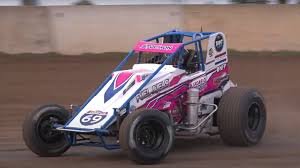
When Friday came (the first of two nights of the Mopar Million), thousands and thousands of fans and 138 competitors were on hand. Friday was set aside for qualifying and heat races. Unfortunately, it was a typical Eldora track that saw it needing moisture. The push trucks ironing out the surface only raced dust. The result was that drivers tagged the wall numerous times during hot laps and qualifying.

The format for the race called for an invert of six cars in each of the heat races, meaning that the fastest car started sixth in the heat race. The top two finishers in each race would go to the A Feature, next two fastest to the B Feature, next two to the C and on down. The first several heat races were exciting and competitive, but then the track rubbered down, and passing was limited.
J.J. Yeley racing with Tony Stewart Racing and with Mopar power came into the race as the team to beat having dominated USAC Sprint Car racing in 2002. When qualifying ended veteran USAC driver Tracy Hines set fast time with a lap of 15.918 with Tyler Walker second and Yeley third. The fast two cars in qualifying were guaranteed a starting spot in the A Feature.
The first five heats were exciting, but once the track took rubber passing was at a premium. Perhaps the surprise of the heat races was that fast qualifier Tracy Hines flipped wilding down the stretch in heat one, eliminating him from qualifying through the heat races but as fast qualifier he would start 21st in the Mopar Million. Tyler Walker also failed to qualify through the heat and started 22nd in the A feature.
The format for lining up the feature saw the winner of the tenth heat, veteran Brad Noffsinger on the pole with the winner of heat nine starting second, etc. 11th starting spot went to the runner-up in heat one and on down. The top four in Saturday night’s B feature rounded out the field for the 26-car Mopar Million.
Saturday, things started off with a 15-lap F feature which saw the top four cars transferring to the back of the E Feature, with the same format holding true for the D Feature, the C Feature and the B Feature. The top fours cars from the B Feature that transferred to the tail end of the A Feature were veteran Brian Tyler, Jon Stanrough, Bud Kaeding and Danny Smith. The line-up was set for the 26-car, 40-lap feature with winning taking home $200,000.
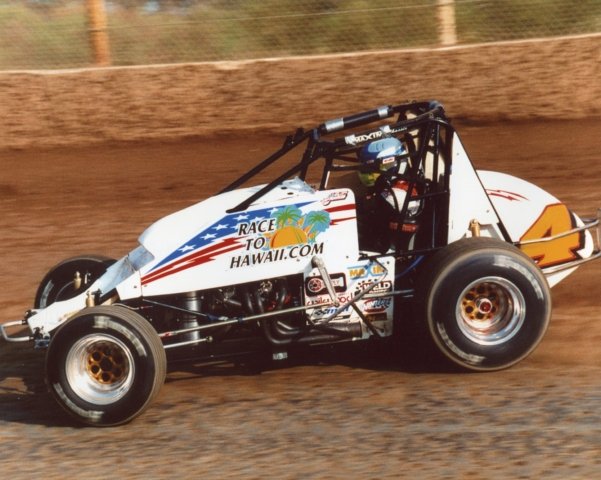
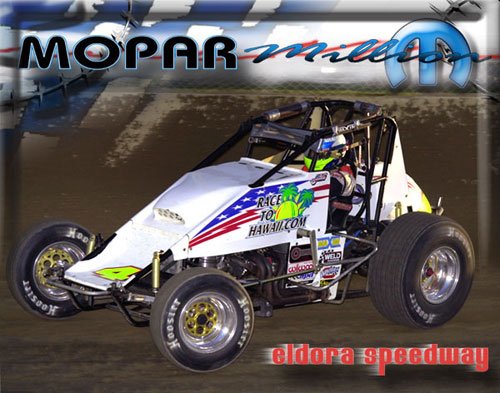
After all the fanfare was over, the 26 drivers strapped themselves in for the biggest purse in Sprint Car History. Russ Gamester got the lead at the drop of the green but Ohioan Dean Jacobs took the point in turn four for of the opening lap and led until lap 19 when Indiana’s Dickie Gaines charged to the lead after racing from his 15th starting position.
Two cautions bunched the field up, on lap 25 for a four-car tangle and again on lap 28 when Bud Kaeding hit the turn four wall. On the restart after the second caution, “The Wild Child” Jac Haudenschild of Wooster, Ohio slide past Gaines in turn two to grab the point. A lap later the caution waved again.
When the green waved again, it turned out to be for the final 11 laps which turned out to be a classic. Stevie Smith got around Dick Gaines for second on the high side and then went after Haudenschild. Smith got to Haud’s rear bumper several times and made one last ditch shot but came up a car length short.
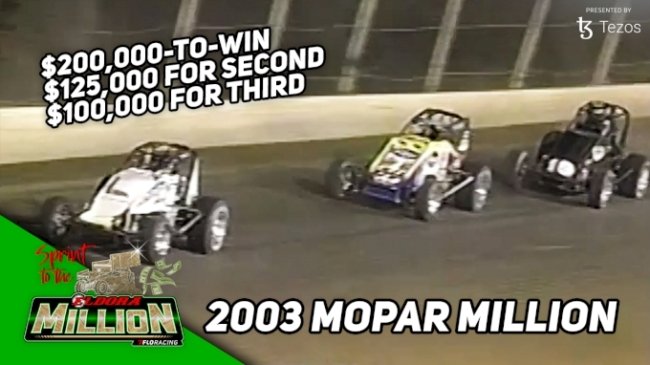
At the checkers it was Haudenschild, Smith, Gaines, Mopar’s hope J. J. Yeley, who put on a good drive to finish fourth and Rob Chaney fifth. In victory lane Haudenschild said. “This is unbelievable, I can’t believe we won the race. I have to let this sink in.” But then Eldora was Haud’s track, and he won several big money races there.
For Smith, who was an outstanding winged sprint car driver, non-winged sprint car racing was something he had very little experience at and he credited his dad Steve Smith, who had a lot of non-winged experience for doing a great job setting up the car. “I didn’t want to go in there and spin or crash, so I tried to get alongside him.” Said Smith. But he (Haud) knows how to run this track. He is one of the best at this place.
So, the biggest paying Sprint Car race in history had been a success, thanks to Earl Baltes’ willingness to take the risk, for USAC sanctioning the event and for Mopar to stepping up and helping with financing and helping give the race credibility.